Interior Design Fundamentals · 2026
What Is Interior Design in One Word?
If you had to describe interior design with one meaningful word,
harmony is a useful answer: bringing space, function,
colour, furniture, lighting and materials together into one cohesive
environment.
Quick Answer
Interior Design in One Word: Harmony
Harmony
Harmony describes the way different parts of an interior work together
as a cohesive whole. A successful room does not require every item to
match. Instead, furniture, colour, materials, lighting, proportions,
textures and spatial planning should have an intentional relationship.
This is a useful way to summarize the design objective, but it is not a
universal one-word definition. Interior design is a broader discipline
involving planning, functionality, aesthetics, materials, lighting,
furniture and technical coordination. :contentReference[oaicite:1]{index=1}
Meaning
What Does Harmony Mean in Interior Design?
In interior design, harmony means that individual elements appear to
belong together. The room has a sense of visual connection rather than
looking like a collection of unrelated objects.
Harmony can come from repetition, related colours, compatible materials,
consistent proportions, similar forms, coordinated lighting and logical
spatial planning.
Harmony Does Not Mean Everything Must Match
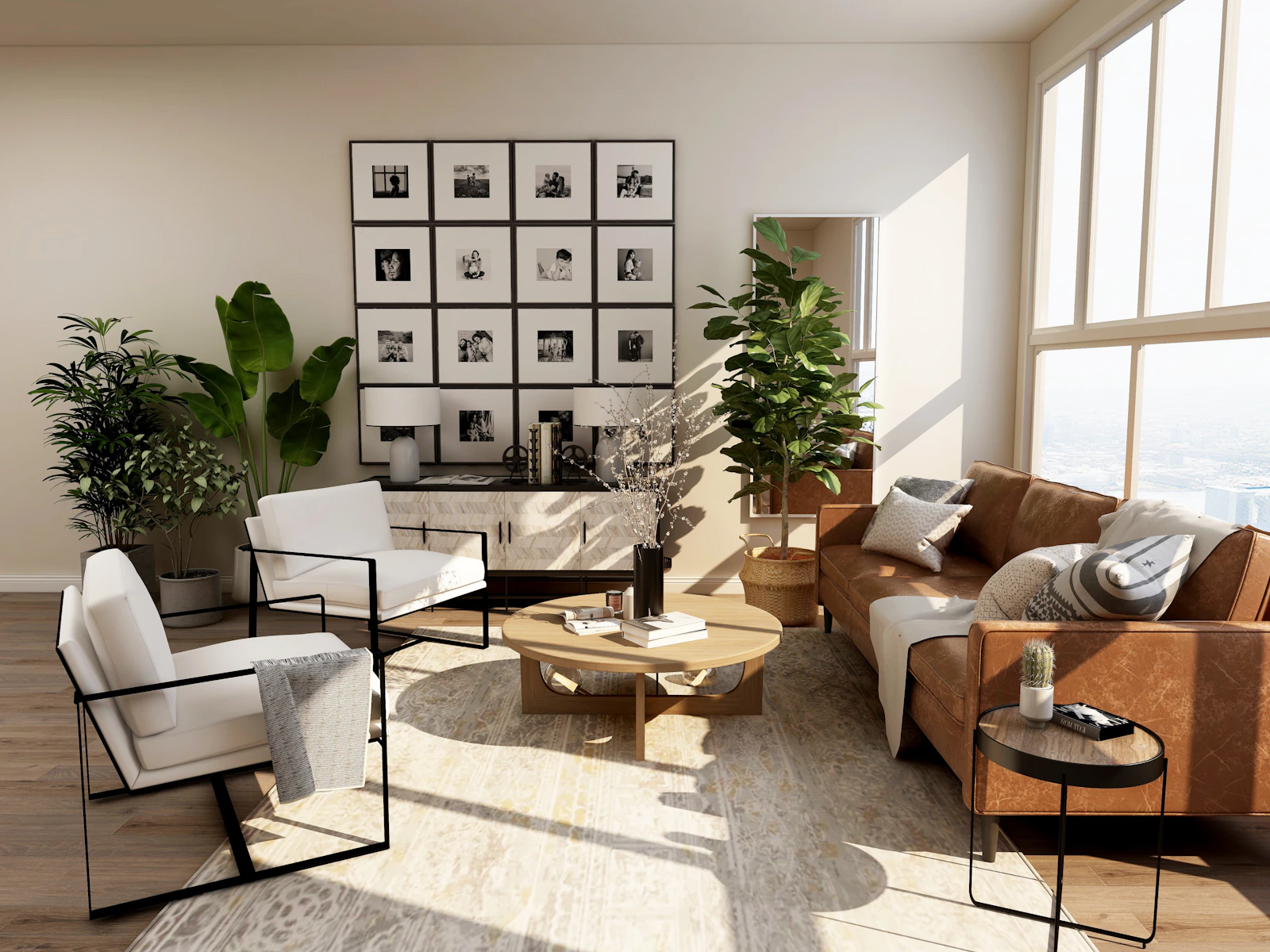
A harmonious room can contain contrast. A dark accent wall can work with
light furniture. A round coffee table can work with a rectangular sofa.
Wood can work with stone and metal. The key is that the differences are
intentional and connected to the overall design.
Why It Matters
Why Is Harmony Important in Interior Design?
Interior design is concerned not only with appearance but also with how
people use and experience a space. Current Interior A to Z guidance
describes interior design as combining space planning, furniture,
lighting, colour, materials and styling to create functional and cohesive
environments. :contentReference[oaicite:2]{index=2}
01Visual Clarity
Related colours, forms and materials make it easier for the eye to
understand the composition of a room.
02Comfort
Good planning and appropriate furniture proportions contribute to a
space that feels comfortable to use.
03Consistency
Repeated materials, colours and design details can connect separate
rooms into one coherent home.
04Function
Harmony is not purely visual. Furniture, storage and circulation must
also work together practically.
05Personality
A cohesive design can still express the homeowner’s individual taste,
lifestyle and preferences.
06Long-Term Appeal
A coordinated foundation can make it easier to update accessories and
furnishings without redesigning the entire room.
The Formula
How Do You Create Harmony in an Interior?
Think of harmony as a relationship between multiple design decisions
rather than one decorative trick.
01 · Space
Harmony Starts With Space Planning
Before selecting décor, a designer needs to understand how the available
space will be used. Furniture placement, circulation, storage and room
zoning determine the functional foundation of an interior.
- Measure the room before selecting furniture.
- Identify doors, windows and fixed architectural elements.
- Plan circulation paths.
- Separate different activities into useful zones.
- Allow enough negative space around furniture.
- Plan storage before decorative elements.
- Consider how adjacent rooms connect visually and functionally.
Example:
A living room can contain beautiful furniture and still feel
unsuccessful if the sofa blocks movement, the coffee table is too
large or there is insufficient space between seating areas.
Learn more about space planning →
02 · Colour
Colour Harmony Makes a Room Feel Connected
Colour harmony does not mean using only one colour. It means creating
relationships between dominant, supporting and accent colours.
Dominant Colour
Used across larger visual areas such as walls, major furniture or
large architectural surfaces.
Supporting Colour
Appears through furniture, curtains, cabinetry, rugs and selected
architectural details.
Accent Colour
Adds controlled contrast through artwork, cushions, accessories or
selected furniture pieces.
Practical Colour Rule
Instead of choosing every colour independently, select a small palette
and repeat its tones in different rooms, materials and accessories.
03 · Materials & Texture
Material Harmony Adds Depth
Harmony becomes more sophisticated when materials have both similarities
and controlled differences. Wood, stone, fabric, glass and metal can
coexist when their colours, textures and proportions are coordinated.
| Material | Visual Contribution | Useful Relationship |
|---|
| Wood | Warmth and natural texture | Works with stone, fabric and matte finishes. |
| Stone | Visual weight and natural pattern | Can balance warm wood and softer textiles. |
| Fabric | Softness and comfort | Helps soften hard architectural surfaces. |
| Glass | Transparency and visual lightness | Can reduce the visual weight of partitions and furniture. |
| Metal | Detail and contrast | Useful as a controlled accent through hardware and lighting. |
04 · Lighting
Lighting Connects the Entire Interior
Lighting influences how colour, texture, materials, furniture and
architecture are perceived. Current Interior A to Z guidance describes
layered lighting through ambient, task and accent functions. :contentReference[oaicite:3]{index=3}
Ambient Lighting
Provides general illumination and establishes the overall brightness
of the room.
Task Lighting
Supports activities such as cooking, reading, working and grooming.
Accent Lighting
Highlights artwork, architectural features, textures and selected
decorative objects.
Good lighting harmony also means considering daylight. The same wall
colour or material can look different under morning sunlight, evening
light and artificial illumination.
05 · Furniture & Proportion
Furniture Must Work With the Room
Furniture is one of the strongest contributors to the visual and
functional character of an interior. Harmony requires attention to
scale, proportion, shape, circulation and material.
Start With Function
Decide what people need to do in the room before choosing furniture.
Check Scale
Make sure furniture dimensions suit the room rather than selecting
pieces only because they look attractive individually.
Coordinate Forms
Combine straight and curved forms intentionally instead of allowing
every object to compete.
Repeat Materials
Repeat selected wood tones, metals or upholstery colours to create
visual continuity.
Protect Circulation
Furniture should support comfortable movement rather than filling
every available area.
Harmony vs Matching
Does Harmony Mean Everything Has to Match?
No. Matching every item can actually make an interior feel predictable.
Harmony is broader: it is about relationships.
Too Much Matching
- Identical furniture finishes everywhere.
- One colour repeated without variation.
- Every shape follows the same geometry.
- Little material contrast.
- Limited visual hierarchy.
Balanced Harmony
- Related but not identical colours.
- Repeated materials used selectively.
- Contrast between hard and soft textures.
- Different forms with compatible proportions.
- A clear visual hierarchy.
Room by Room
What Does Harmony Look Like in Different Rooms?
Living Room
Coordinate sofa proportions, coffee table scale, wall treatments,
lighting, rug size and accent colours.
Bedroom
Use a calm palette, balanced bedside elements, soft textures and
comfortable lighting.
Kitchen
Connect cabinetry, countertop, backsplash, flooring, handles and
lighting into one material language.
Dining Room
Coordinate table scale, chairs, pendant lighting, wall treatment and
circulation around the dining area.
Home Office
Combine ergonomic furniture, task lighting, storage and a visually
calm background.
Small Apartment
Prioritize circulation, appropriate furniture scale, storage,
consistent colours and controlled visual complexity.
The Bigger Picture
Harmony Connects the Elements of Interior Design
Interior design involves multiple elements and principles. Interior A to
Z’s educational content describes space, line, form, colour, texture,
pattern and light as key design elements, while principles such as
balance, proportion, rhythm and contrast help organize those elements.
:contentReference[oaicite:4]{index=4}
| Design Component | Contribution to Harmony |
|---|
| Space | Creates functional relationships and comfortable circulation. |
| Line | Creates visual direction and continuity. |
| Form | Creates shape, structure and visual character. |
| Colour | Connects different areas through coordinated tones. |
| Texture | Adds depth and tactile variation. |
| Pattern | Creates repetition and visual rhythm. |
| Light | Reveals materials, forms, colours and architectural details. |
This is why harmony is useful as a one-word summary: it describes the
relationship between the different parts rather than one individual
design feature.
Design Principles
Harmony and Balance Are Different
Harmony and balance are closely related but they are not identical.
Balance concerns the distribution of visual weight, while harmony is
concerned with how different elements relate to one another.
Balance
Ask: Does the visual weight feel appropriately distributed?
- Symmetrical balance
- Asymmetrical balance
- Radial balance
- Visual weight
Harmony
Ask: Do the different elements feel connected?
- Related colours
- Compatible materials
- Repeated forms
- Consistent proportions
Common Mistakes
5 Things That Can Break Interior Harmony
1. Too many unrelated colours
A large number of competing colours can weaken visual continuity.
2. Inconsistent furniture scale
Furniture that is too large or too small can disrupt the proportions
of an otherwise attractive room.
3. Too many materials
Using many unrelated finishes can make a space feel visually noisy.
4. Ignoring lighting
Poorly coordinated lighting can change how colours and materials
appear and weaken the intended atmosphere.
5. Buying furniture before planning
Selecting individual pieces first can make it difficult to achieve
a coherent layout later.
Professional Approach
How Interior Designers Build Harmony Step by Step
Understand the User
Identify lifestyle, functional requirements, preferences and
priorities.
Analyse the Space
Study dimensions, architecture, natural light, circulation,
constraints and opportunities.
Develop a Concept
Establish a visual direction for colour, materials, furniture,
forms and atmosphere.
Plan the Layout
Resolve furniture, storage, circulation and functional zoning.
Coordinate Materials
Select finishes, textures, colours and hardware that support the
overall design language.
Design the Lighting
Combine natural and artificial lighting to support function and
reveal the design.
Review the Whole
Check whether every major element supports the concept rather than
competing with it.
Practical Test
How to Check Whether a Room Has Harmony
Stand at the entrance of the room and ask these questions:
- What do I notice first?
- Is there a clear focal point?
- Do the major furniture pieces feel correctly scaled?
- Are the colours related?
- Do the materials complement one another?
- Is there enough negative space?
- Does the lighting support the room’s purpose?
- Are textures balanced?
- Do adjacent rooms feel connected?
- Is anything competing unnecessarily for attention?
The simplest test:
Remove one element at a time mentally. If removing an object makes the
composition clearer, ask whether that object is genuinely contributing
to the design.
Delhi NCR Homes
Harmony in Modern Homes in Gurgaon, Noida and Delhi NCR
In urban homes, harmony often depends on making limited space, storage,
furniture, lighting and materials work together. Interior A to Z’s
current guidance highlights space utilization, furniture planning,
lighting, colour coordination and material selection as important parts
of modern residential interiors. :contentReference[oaicite:5]{index=5}
Gurgaon
Use consistent materials and furniture proportions to connect
apartments, builder floors and larger residences.
Noida
Space-efficient layouts, coordinated storage and layered lighting
can help maintain both function and visual continuity.
Delhi NCR
A consistent design language can connect living rooms, bedrooms,
kitchens and circulation spaces into one cohesive home.
Continue Learning
Related Interior Design Guides
FAQs
Frequently Asked Questions
What is interior design in one word?
Harmony is a useful one-word description of interior
design because successful interiors bring space, function, colour,
furniture, lighting and materials together into a cohesive whole.
Why is harmony important in interior design?
Harmony helps different parts of an interior feel connected rather
than random. It can be created through related colours, materials,
forms, proportions, lighting and spatial planning.
Is harmony the only definition of interior design?
No. Harmony is an interpretive one-word summary, not a universal
dictionary definition. Interior design is a broader discipline
involving planning, functionality, aesthetics, materials, lighting,
furniture and technical coordination.
What creates harmony in interior design?
Coordinated colour palettes, repeated materials or forms, suitable
scale and proportion, balanced furniture arrangements, consistent
lighting and intentional visual relationships can all create harmony.
What is the difference between harmony and balance?
Balance concerns the distribution of visual weight, while harmony
concerns how different design elements relate to one another as a
cohesive whole.
Does harmony mean everything has to match?
No. Harmony can include contrast. Different colours, materials and
forms can work together when they have an intentional relationship.
Can a modern home have harmony without looking boring?
Yes. Modern interiors can combine contrasting textures, accent
colours, curved and straight forms, natural materials and lighting
while maintaining a coherent overall design.
Is harmony a design principle?
Harmony is commonly discussed as a design principle or quality of
composition, although terminology varies between design education
frameworks. It describes the sense of relationship and cohesion
between elements.
Design Is More Than Decoration
When space, function, colour, furniture, materials, lighting and
proportions work together, an interior becomes more than a collection
of beautiful objects. It becomes a cohesive environment.
Interior A to Z provides interior design information and residential and
commercial interior design services across Delhi NCR, including Gurgaon
and Noida.